
Is Artificial Intelligence the Future of Audit or Just a Fancier Calculator?
Introduction
Auditors across the globe are asking this provocative question: Can artificial intelligence truly transform the audit profession or is it merely speeding up what humans already do? This debate is not just academic — it challenges how audits are conducted, how risks are detected, and how professionals must adapt to a rapidly evolving landscape.
In 2026, AI is not optional in auditing — it is accelerating change, reshaping expectations, and redefining what quality assurance means. But to understand why this matters, we must dig into the nuts and bolts of how AI stacks up against traditional audit methods, where it delivers the most value, and what auditors should do today to stay ahead.
Traditional Audit vs AI-Powered Audit: What is the Difference?
| Feature | Traditional Audit | AI-Powered Audit |
|---|---|---|
| Data Scope | Limited sampling (e.g., 1-5% of transactions) | Full data processing (100% population) |
| Time to Completion | Weeks to months | Hours to days |
| Risk Detection | Focus on manual checks and sampling | AI flags anomalies + implicit risk patterns |
| Human Involvement | Manual data extraction, reconciliation | Auditors focus on insights and professional judgment |
| Real-Time Assurance | Post-period audits only | Continuous monitoring and alerts |
| Skill Requirements | Accounting + auditing standards | Accounting + AI tools + data literacy |
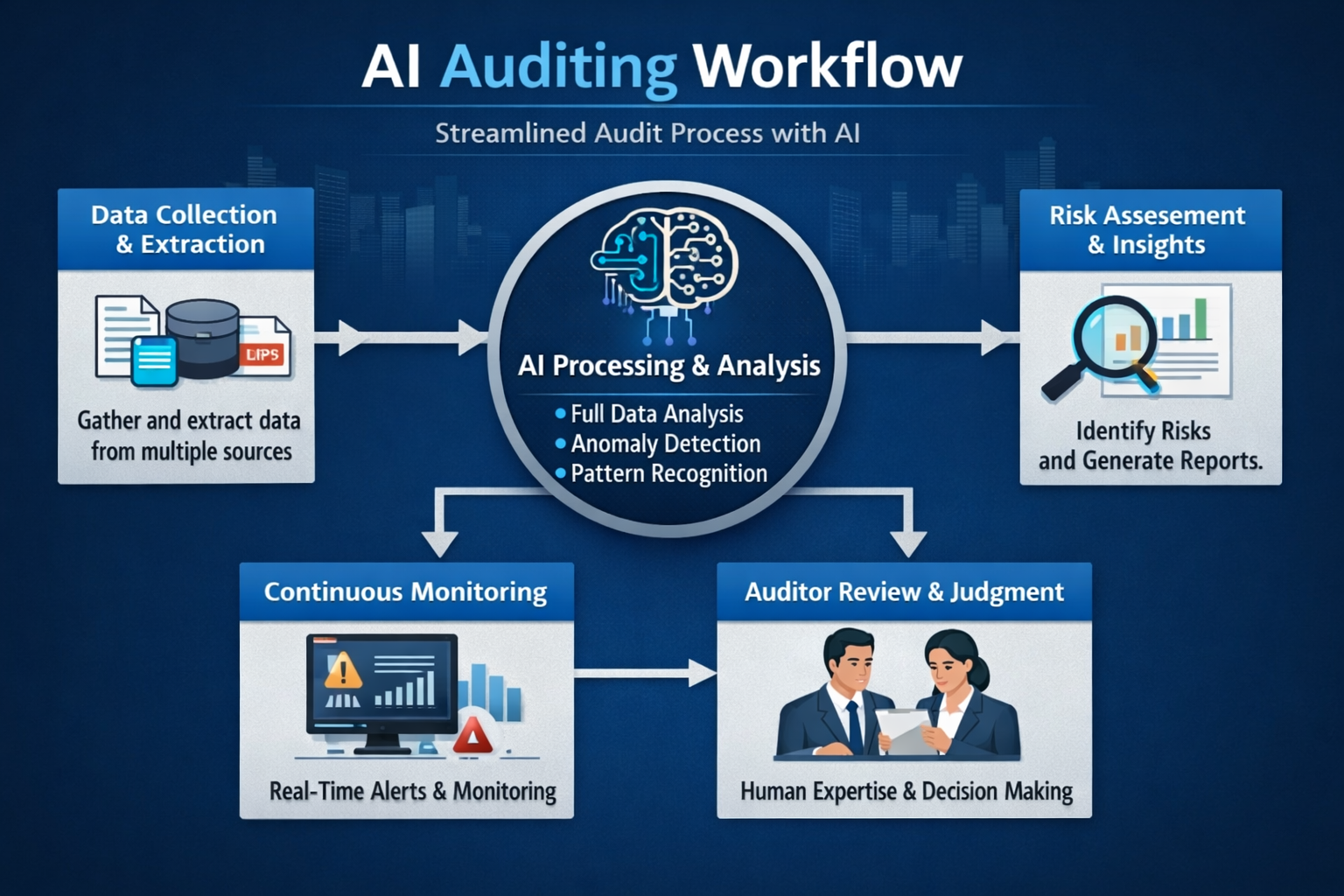
Key takeaway: AI does not replace auditors — it transforms how audit work is done. Auditors shift from repetitive tasks to strategic analysis and interpretation.
Where AI Is Already Making an Impact
1. Automated Data Extraction and Preparation
AI tools can ingest complex documents (PDFs, contracts, ledgers) and convert them into structured, audit-ready datasets in minutes — a task that once took days.
2. Full-Population Risk Analysis
Instead of sampling 1% of transactions, AI can test all records, revealing hidden patterns and anomalies that manual methods miss.
3. Continuous Monitoring Instead of Periodic Audits
AI systems can monitor financial activity in real time, flagging potential issues as they occur and enabling proactive, not reactive, assurance.
4. Advanced Anomaly and Fraud Detection
Machine learning models are now adept at spotting unusual patterns, questionable entries, or potentially fraudulent behavior across massive data sets — far beyond the scope of human review.
5. Intelligent Spreadsheet Navigation and Review
Major firms like PwC have developed AI agents that can handle enterprise-grade spreadsheets, extracting insights from millions of rows and reducing weeks of work to hours.
Real-World AI in Audit: Examples from the Field
- PwC's AI Agents: Used to automate spreadsheet analysis — a historically tedious task — enabling auditors to focus on deep insights rather than formatting and data entry.
- Deloitte's AI Chatbots: AI chat assistants like PairD help auditors summarize information, extract contract details, and handle large data sets, freeing human auditors for higher-level tasks.
- Continuous Risk Monitoring: Emerging platforms embed AI directly into audit workflows to continuously assess internal controls and flag anomalies in real time.
These examples show how leading professional services firms are blending human expertise with AI automation.
Is AI Better Than Traditional Methods?
Comparison: Speed vs Context
- AI excels at speed, scale, and pattern recognition — it processes massive datasets, performs full data risk analysis, and highlights anomalies auditor teams would likely miss manually.
- Humans excel at judgment, context, and ethical decision-making. AI tools support decisions but do not make professional judgments on intent or interpretation.
So it is not a matter of "AI vs Traditional" — but "AI + Human Expertise vs Traditional Alone".
AI is not better on its own — but when integrated with professional knowledge, audit quality and efficiency rise significantly.
Potential Challenges and Risks
Data and Algorithm Transparency
AI systems are probabilistic and sometimes opaque. Regulators and auditors alike are concerned about explainability — being able to retrace the decision path used by AI when verifying conclusions. This is a compliance gap that auditors must bridge with governance, documentation, and explanation frameworks.
Ethical and Regulatory Oversight
Regulators have noted that firms still lack formal monitoring of how AI impacts audit quality — meaning the industry must invest in metrics, oversight, and governance for responsible AI use.
Changing Skill Requirements
Auditors need not just accounting knowledge but data analytics, AI literacy, and ethical understanding to leverage AI tools effectively.
Practical Guidance: How Auditors Should Prepare in 2026
1. Invest in AI Literacy
Auditors must learn how to use AI audit tools, understand their outputs, and critically evaluate model recommendations.
2. Focus on Professional Judgment
AI may surface risks — but only humans can interpret context, legal implications, and ethical dimensions of audit findings.
3. Develop Data Fluency
Understanding data structures, patterns, and interpretation enhances how auditors validate AI results.
4. Advance Continuous Auditing Skills
Auditors should move beyond annual or quarterly reviews toward continuous assurance frameworks powered by AI insights.
5. Engage With Governance and Ethics
AI use must align with ethical standards and regulatory expectations. Auditors should lead the development of AI governance frameworks within organizations.
Conclusion: A New Era, Not a Replacement
Artificial intelligence is not here to replace auditors — but to empower auditors to do better work faster. AI excels in processing data, detecting anomalies, and automating tedious tasks, but it still needs human oversight, judgment, and professional skepticism.
The future of auditing in 2026 and beyond will be shaped by those who embrace AI tools and retain the human skills that machines cannot replicate. In that sense, the question is not whether AI will win — it is whether auditors will adapt and lead.
At AAG & Co., we specialise in audit technology advisory and AI integration services to help firms navigate this transformation seamlessly. Contact our team for personalised guidance on implementing AI-powered audit solutions.

CA Ajit Kumar
Specialised in audit technology, AI integration in assurance services, and regulatory compliance. Our team of Chartered Accountants and technology professionals helps firms navigate the evolving audit landscape with precision and strategic insight.