
Auditing Best Practices in 2026: Are You Auditing for Compliance — or for Competitive Advantage?

Introduction
Is your audit process merely ticking regulatory checkboxes, or is it actively protecting and growing your business?
In today's fast-changing regulatory and digital environment, auditing is no longer just about compliance. It has evolved into a strategic function that strengthens governance, prevents fraud, enhances credibility, and improves operational efficiency.
Whether you are an MSME, a growing startup, or an established enterprise, understanding auditing best practices can significantly improve your financial transparency and decision-making.
This comprehensive guide explores:
- Traditional vs Modern Auditing Practices
- Internal Audit vs Statutory Audit – Which is better?
- Latest auditing trends in 2026
- Practical examples and actionable best practices
Why Auditing Best Practices Matter
An effective audit system delivers measurable business value:
With increasing scrutiny from regulators like the Institute of Chartered Accountants of India (ICAI) and evolving reporting standards such as International Auditing and Assurance Standards Board (IAASB), businesses must adopt structured and updated auditing frameworks.
Traditional vs Modern Auditing: Which One Is Better?
1. Traditional Audit Approach
- Manual documentation
- Periodic (usually annual) audits
- Sample-based verification
- Compliance-focused
- Limited technology use
Example: A manufacturing company conducts an annual statutory audit. The auditor verifies selected purchase invoices, checks GST compliance, and confirms balances with suppliers. The focus remains largely on statutory reporting accuracy.
Limitations: Errors may go undetected throughout the year, fraud detection is reactive, heavy dependency on physical documentation, and time-consuming processes.
2. Modern Risk-Based & Technology-Driven Audit
- Continuous auditing
- Data analytics & AI-based review
- Risk-based sampling
- Real-time transaction monitoring
- ERP integration
Example: A company using cloud-based accounting software integrates automated audit tools. Instead of checking 50 invoices manually, the system analyzes 100% of transactions, flags anomalies, and highlights unusual vendor payments.
Benefits: Early fraud detection, reduced audit time, improved accuracy, better risk assessment, and higher transparency.
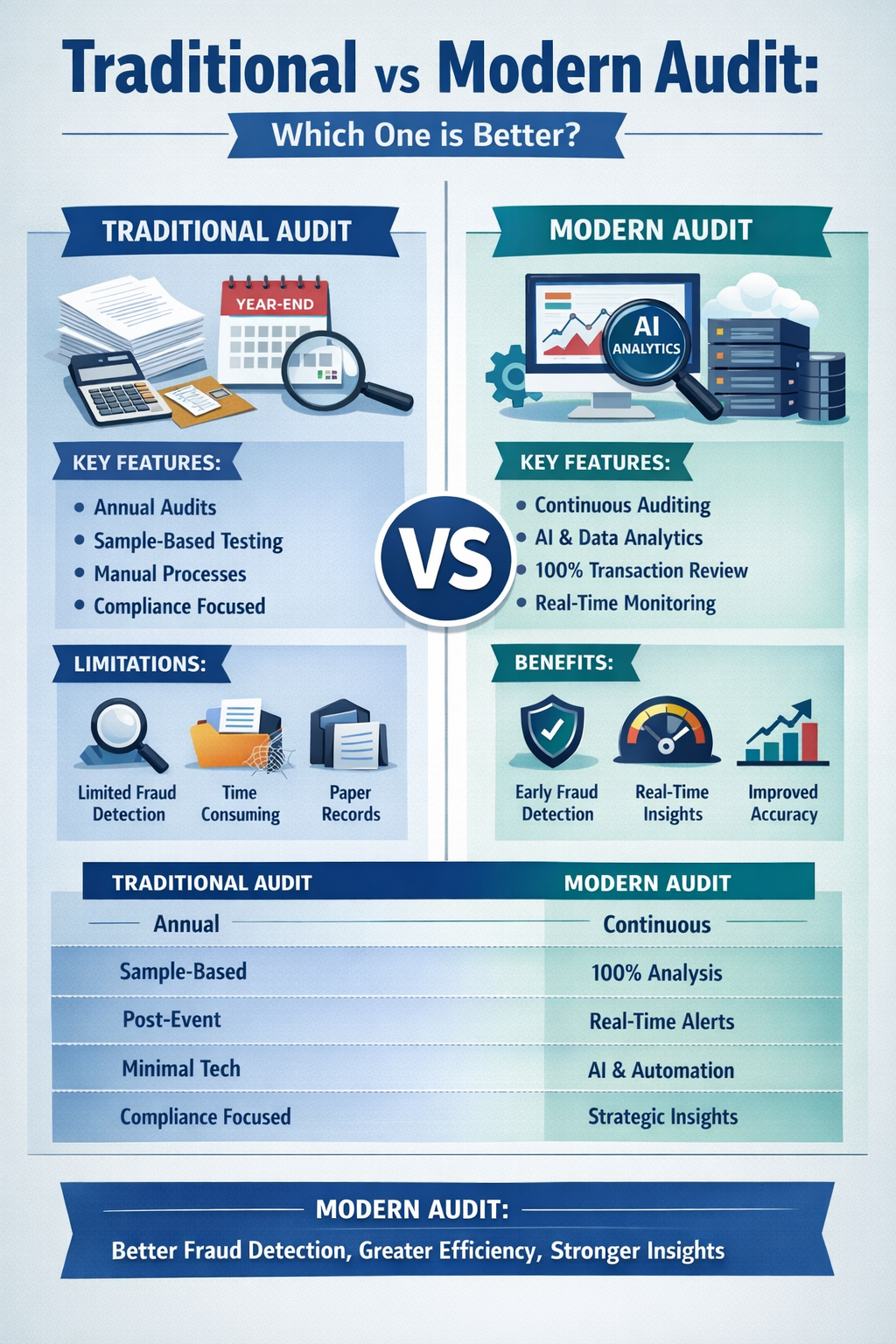
Verdict: Modern, technology-enabled, risk-based auditing is significantly more effective than traditional audit methods. However, a hybrid model — combining professional judgment with data analytics — delivers the best results.
Internal Audit vs Statutory Audit: Which Should You Prioritize?
- ✓ Mandatory under law
- ✓ Focuses on financial statement accuracy
- ✓ Conducted annually
- ✓ Compliance-oriented
Strength: Ensures regulatory compliance and stakeholder confidence.
Limitation: Limited scope for operational improvement.
- ✓ Voluntary (except specified entities)
- ✓ Ongoing throughout the year
- ✓ Focuses on risk management & efficiency
- ✓ Evaluates internal controls
Strength: Prevents losses proactively.
Limitation: May not satisfy statutory compliance alone.
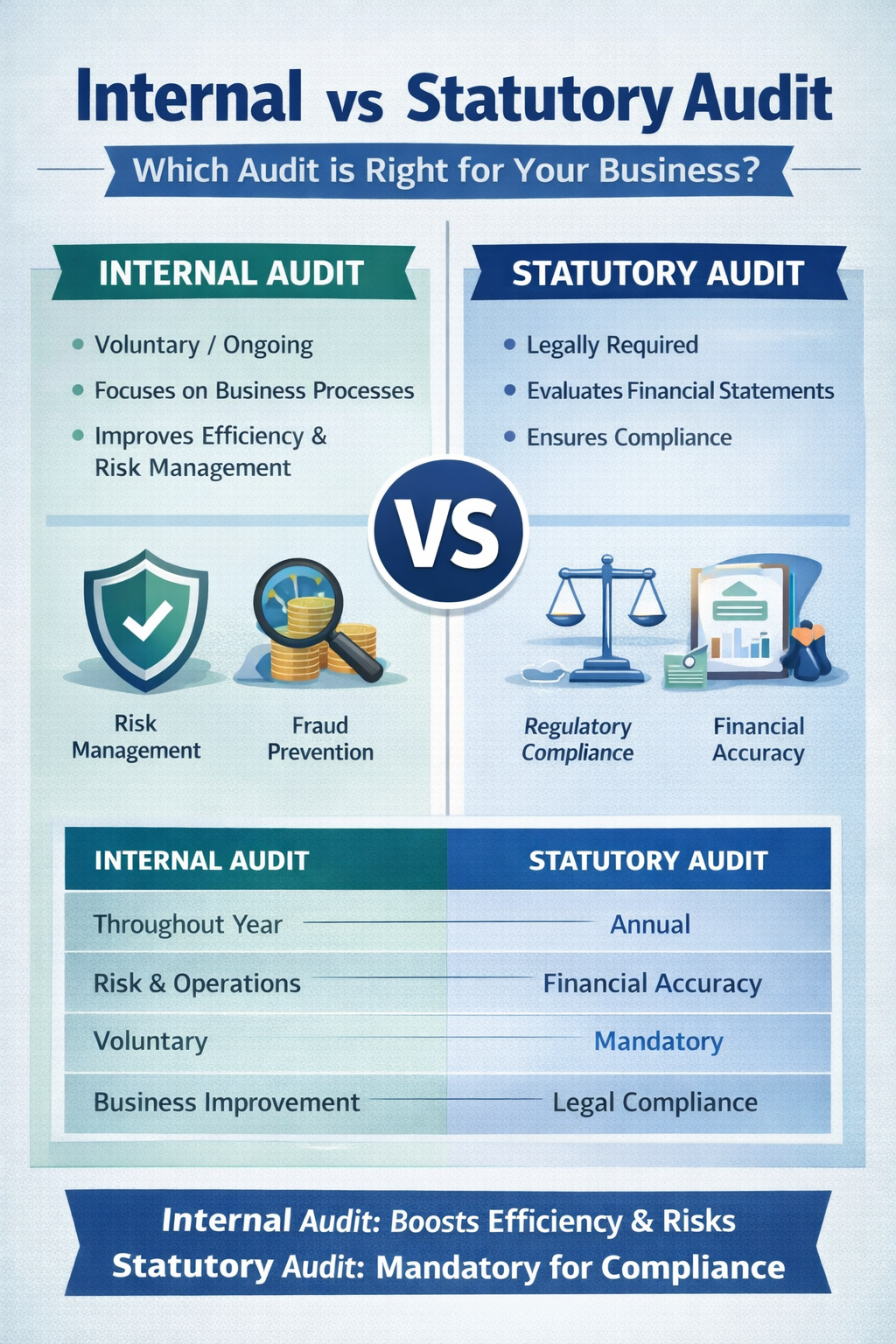
Which Is Better?
If compliance is your only concern → Statutory Audit is essential.
If business growth and risk prevention matter → Internal Audit adds greater value.
Best practice: Implement both. Use internal audit as a preventive tool and statutory audit as a validation mechanism.
Latest Auditing Practices in 2026
Auditing is rapidly evolving. Here are the most important latest auditing trends:
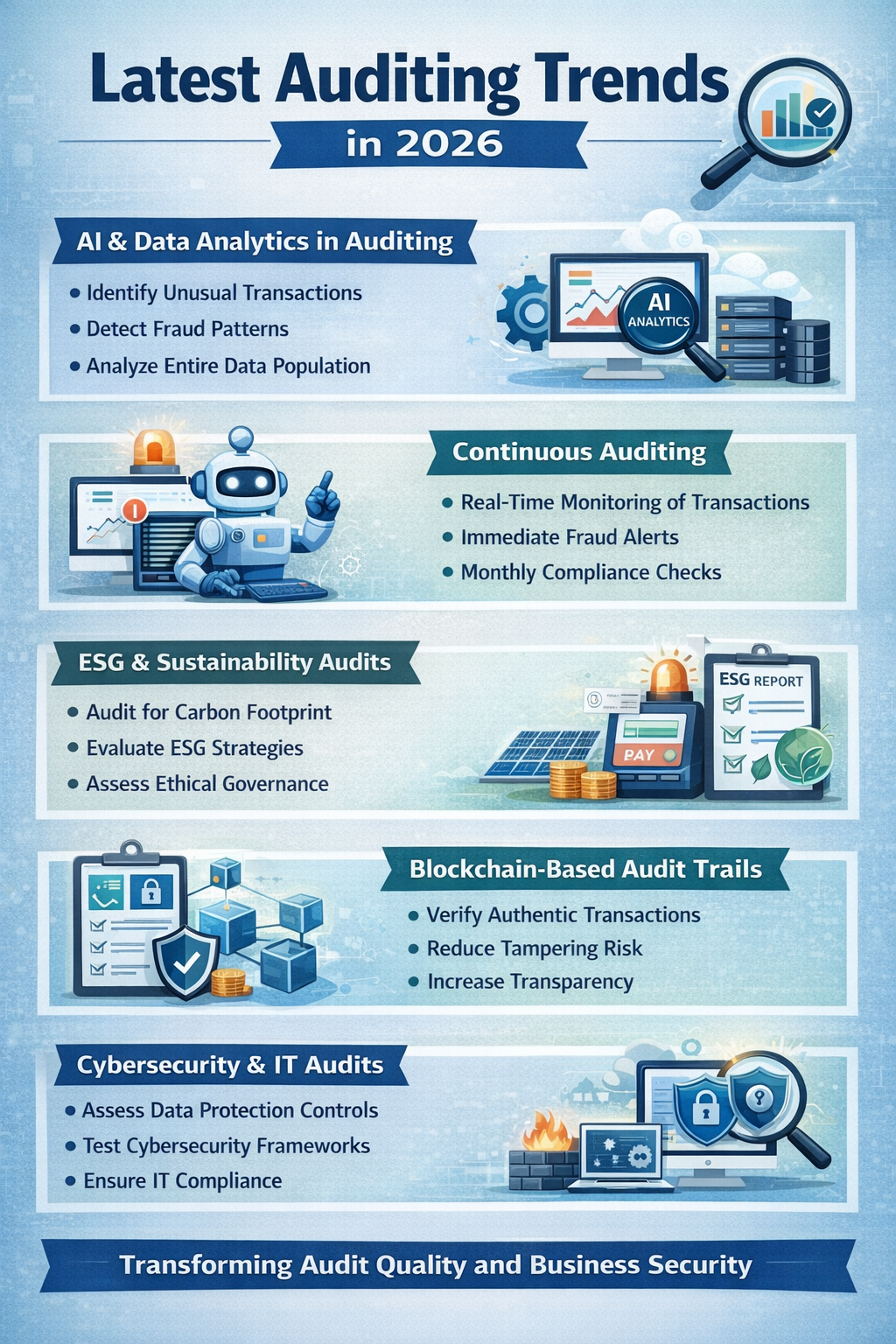
Auditors now use artificial intelligence to:
- Identify unusual transactions
- Detect fraud patterns
- Perform predictive risk analysis
- Analyze 100% population instead of samples
This dramatically improves audit quality and efficiency.
Instead of annual reviews, companies adopt real-time monitoring systems that flag:
- Suspicious payments
- Compliance deviations
- Cash flow irregularities
This reduces year-end surprises.
Environmental, Social, and Governance (ESG) reporting is becoming critical. Investors demand transparency beyond financial statements.
Auditors now assess:
- Carbon footprint disclosures
- Sustainability metrics
- Ethical governance practices
Blockchain creates tamper-proof transaction records. Auditors can verify transaction authenticity without extensive manual confirmation.
This reduces fraud risk significantly.
With increased digital transactions, cybersecurity audits are becoming essential.
Focus areas:
- Data protection controls
- Access management
- Cloud security
- IT governance frameworks
Auditing Best Practices for Businesses
1. Adopt Risk-Based Auditing
Prioritize high-risk areas:
- Cash transactions
- Related-party transactions
- Revenue recognition
- GST compliance
2. Strengthen Internal Controls
Implement:
- Segregation of duties
- Dual authorization systems
- Automated approval workflows
- Regular reconciliation processes
3. Automate Accounting Systems
Cloud-based software improves:
- Real-time reporting
- Audit trail tracking
- Document management
- Data accessibility
Automation reduces manual errors significantly.
4. Conduct Quarterly Internal Reviews
Do not wait for year-end audits. Quarterly reviews help:
- Identify discrepancies early
- Correct accounting errors
- Improve compliance health
5. Maintain Proper Documentation
Proper documentation remains critical even in digital audits:
- Invoice backups
- Contract copies
- Board resolutions
- GST workings
6. Ensure Auditor Independence
Avoid conflicts of interest. An independent auditor provides unbiased reporting and enhances credibility.
Real-World Scenario: Traditional vs Modern Audit
| Factor | Traditional Audit | Modern Audit |
|---|---|---|
| Frequency | Annual | Continuous |
| Coverage | Sample-based | 100% transaction analytics |
| Fraud Detection | Post-event | Real-time alerts |
| Technology | Minimal | AI & Data analytics |
| Business Insight | Limited | Strategic insights |
Conclusion: Modern auditing practices provide stronger risk mitigation, better efficiency, and higher transparency.
Common Audit Mistakes Businesses Make
- Treating audit as a year-end formality
- Ignoring internal controls
- Poor documentation
- Not leveraging technology
- Delayed reconciliations
Avoiding these mistakes strengthens long-term financial health.
Final Thoughts: Audit as a Strategic Tool
Auditing is no longer just about satisfying regulators. It is about:
- Protecting business assets
- Enhancing governance
- Preventing fraud
- Improving profitability
- Building stakeholder trust
The question is no longer "Do we need an audit?"
The real question is: "Are we using audit as a strategic growth tool or just as a compliance requirement?"
Businesses that adopt modern auditing best practices will not only remain compliant but also gain a powerful competitive advantage in 2026 and beyond.

Nidhi Garg
Partner at AAG & Co. specializing in Audit & Assurance and Risk Advisory. With extensive experience in internal controls and regulatory compliance, she helps businesses transform their audit functions from compliance exercises into strategic advantages.