
Supply Chain Finance: A Strategic Guide for 2026
Introduction
Have You Ever Wondered Why Some Businesses Thrive During Disruptions While Others Struggle—Is Supply Chain Finance the Hidden Advantage They Are Using?
In an era marked by global supply chain shocks, rising trade finance gaps, and intensifying competition, traditional financing tools are no longer enough. Today, progressive companies are turning to Supply Chain Finance (SCF) to strengthen cash flow, deepen supplier relationships, and secure resilient operations. But what exactly is it, how does it compare with other financing methods, and which approach should your business choose? This comprehensive guide will answer all that—and more.
What Is Supply Chain Finance?
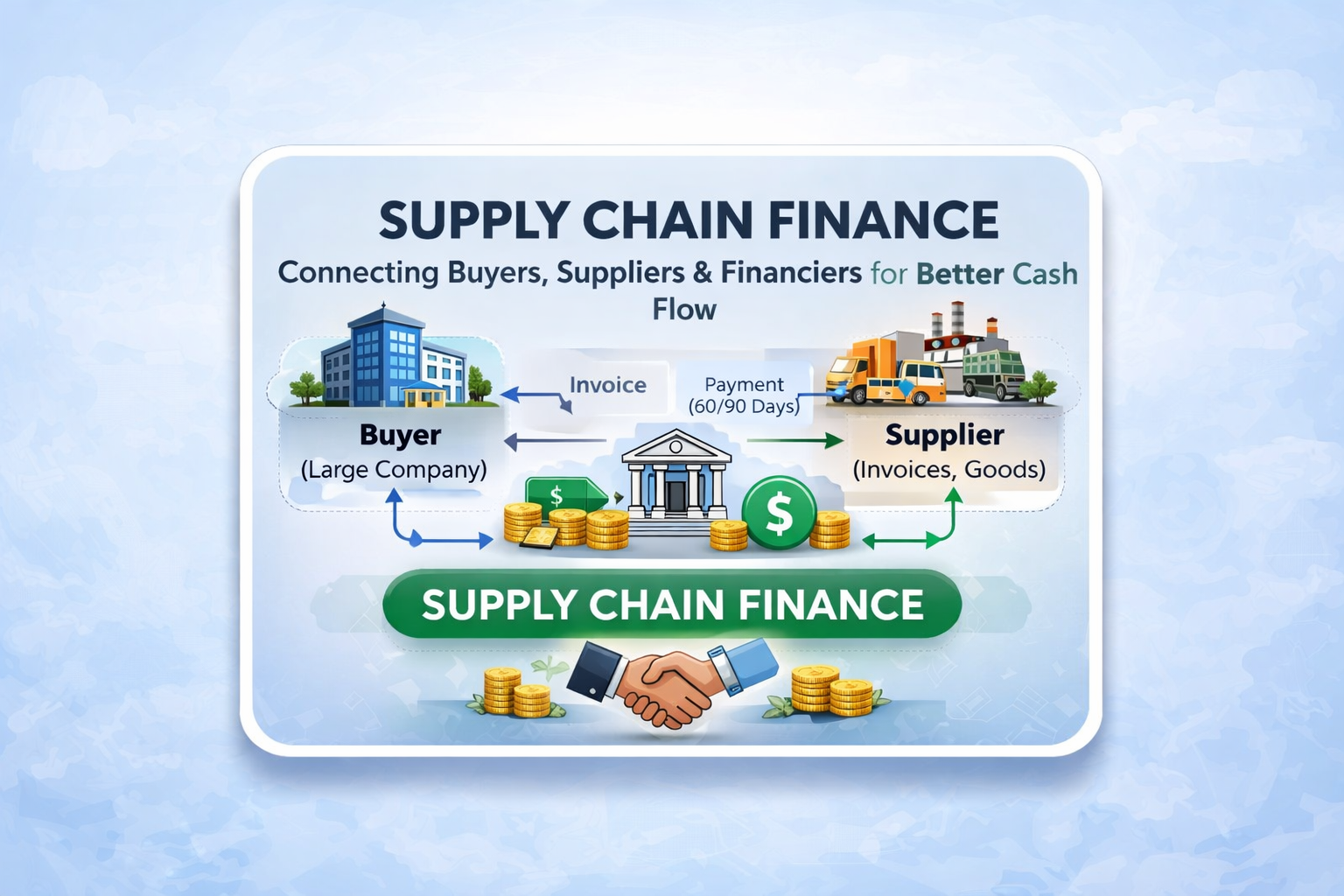
At its core, Supply Chain Finance is a set of financing solutions that optimises cash flow across a buyer-supplier network. Instead of waiting 30-90 days for payment, suppliers can receive early payment from a financier at a small discount, while buyers can extend their own payment terms without harming supplier liquidity. The financier pays the supplier quickly and collects the full amount from the buyer later. This creates a win-win for both parties.
How It Works (Simple Example)
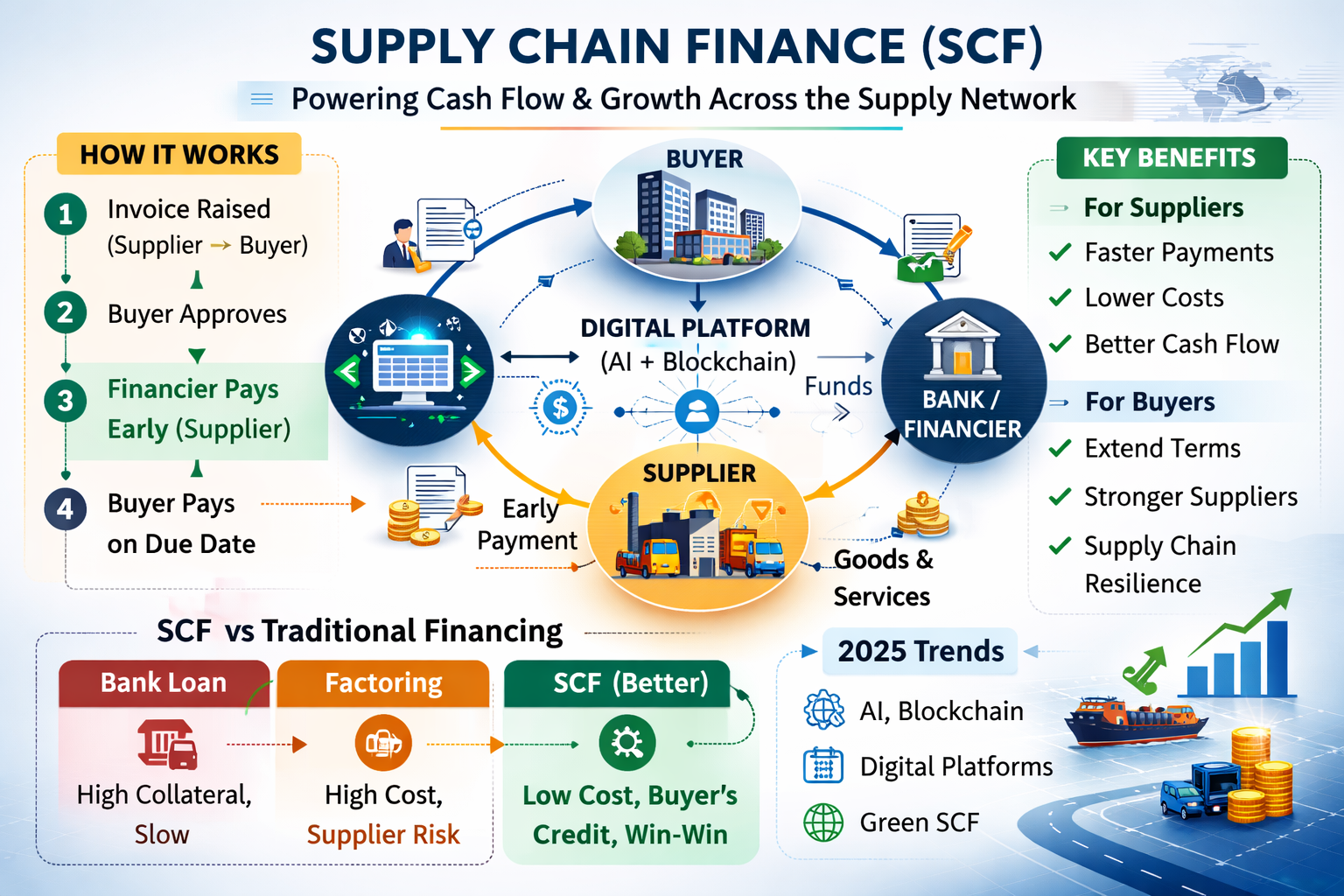
- A supplier issues an invoice to a buyer with standard payment terms (e.g., 60 days).
- The buyer approves the invoice.
- A financing partner pays the supplier early at a small fee.
- The buyer pays the financier on the original due date.
This structure helps suppliers get cash faster and allows buyers to invest their working capital elsewhere.
Why SCF Is More Powerful Than Traditional Financing
When reviewing finance tools, several common alternatives to SCF come up: traditional bank loans, factoring, and trade finance. Let us compare them.
Supply Chain Finance vs Traditional Bank Loans
| Feature | SCF | Bank Loan |
|---|---|---|
| Depends on supplier's credit | No (uses buyer's credit) | Yes |
| Collateral requirement | No | Often yes |
| Impact on supplier's balance sheet | Minimal | Yes |
| Speed of funding | Fast | Slower |
SCF wins when suppliers lack credit history but sell to high-credit buyers. Early payments also avoid long approval cycles typical with banks.
SCF vs Factoring
Factoring allows suppliers to sell invoices for immediate cash, but:
- Factoring is initiated by the supplier.
- Cost is based on supplier's credit risk.
- SCF is often cheaper and more reliable because it leverages the buyer's credit rating.
SCF vs Trade Finance
Trade finance is broader and supports international transactions with instruments like letters of credit, guarantees, and export credit. SCF can complement trade finance by improving liquidity within supply contracts, but it is not a substitute for all international risk mitigants. In fact, there is still a $2.5 trillion global trade finance gap, underscoring the need for broader solutions.
Latest Trends Shaping Supply Chain Finance (2025-2026)
SCF is evolving with technology and global reforms. Here is what is driving its future:
1. Deep-Tier Supply Chain Finance
Traditional SCF favoured large suppliers. New deep-tier models now include smaller, multi-tier suppliers, extending liquidity deeper within ecosystems. This improves supply reliability and helps smaller sellers scale.
2. Blockchain and Transparency
Blockchain provides an immutable record of transactions, reducing fraud and improving verification. Smart contracts can automate release of payments when predefined events occur, cutting settlement times.
3. AI-Driven Risk Assessment
Artificial intelligence and predictive analytics are transforming risk evaluation and credit decisions, especially for MSMEs that lack traditional credit histories. This means more inclusion in SCF programs.
4. Digitisation of Financial Instruments
Emerging laws and technologies like the UNCITRAL Model Law on Electronic Transferable Records (MLETR) are enabling digitised trade documents, boosting efficiency and legality.
5. Sustainability and Green SCF
Sustainability-linked incentives encourage greener practices across supply chains. More businesses now tie financing to ESG goals, such as reduced emissions or responsible sourcing.
Benefits: Why Businesses Are Adopting SCF
For Suppliers
- Faster access to funds improves working capital.
- Lower financing costs compared to factoring or bank loans.
- Reduced days sales outstanding (DSO).
For Buyers
- Preserves working capital by delaying payment.
- Stronger supplier relationships and priority in deliveries.
- Opportunity for negotiation of better pricing thanks to financial support.
For the Entire Supply Chain
- Reduced supply chain risk.
- Better planning and inventory optimisation.
- Stronger ecosystem resilience.
Real-World Examples
- In India, digital SCF platforms leveraging AI have cut transaction times by nearly 40% compared to traditional banking.
- Blockchain adoption in manufacturing and retail SCF in India reached around 30% of transactions by 2024.
- Trade Receivable Discounting Systems (TReDS) have boosted monthly financing for MSMEs by over US$2 billion.
How to Implement SCF in Your Business
- Evaluate Your Supply Chain: Identify suppliers with cash-flow challenges and assess payment practices.
- Choose the Right Platform: Look for digital platforms that integrate AI and provide transparent invoice tracking.
- Engage Your Financiers Early: Establish agreements with banks or fintech partners with SCF expertise.
- Educate Stakeholders: Train procurement and finance teams on SCF processes and benefits.
- Monitor KPIs: Track liquidity improvements, cost savings, and supplier satisfaction to measure impact.
Final Thoughts: Which Is Better for You?
If your goal is improving working capital while strengthening supplier resilience, Supply Chain Finance stands out over traditional loans or factoring—especially in a digital, globalised market. For international trade risk mitigation, SCF complements trade finance tools, but does not replace them entirely.
As global supply networks grow more complex, SCF is no longer an option—it is becoming a competitive necessity for businesses that want agility, stronger partnerships, and financial resilience in 2026 and beyond.
At AAG & Co., we specialise in supply chain finance advisory and implementation services to help businesses navigate these transitions seamlessly. Contact our team for personalised guidance on optimising your working capital strategy.

CA Sachin Garg
Specialised in corporate finance, supply chain advisory, and working capital optimisation. Our team of Chartered Accountants and financial professionals helps businesses navigate complex financing landscapes with precision and strategic insight.